
Keeping Time

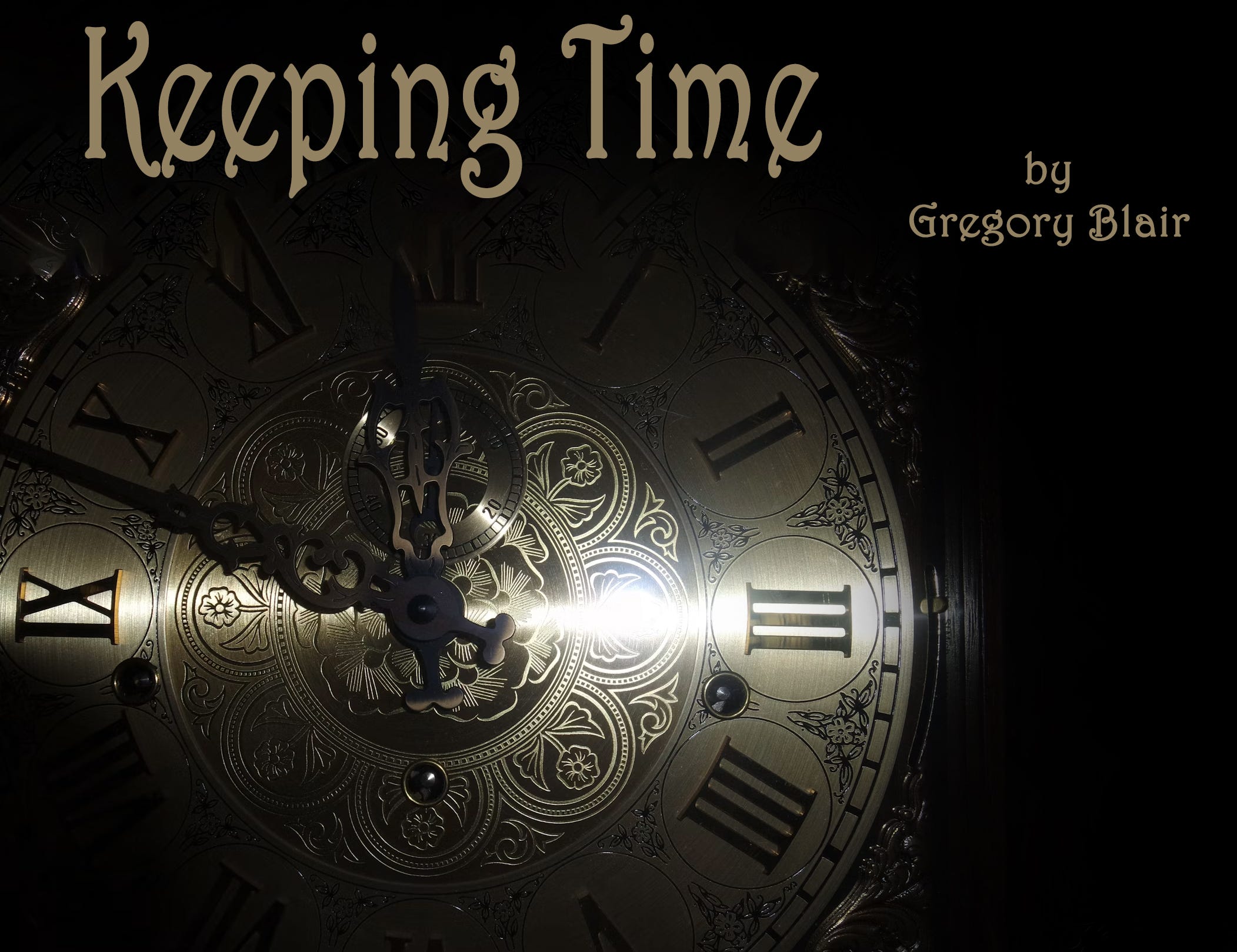
Renowned throughout and beyond Outer Castoria for his expertise in ancient time pieces, Terxis J. McKitterson could ever be found in his famous Atelier of Oddities—a shop of wonders for all to see with its shelves of trinkets and treasures from days gone by alongside mechanical creations and inventions Terxis manufactured from innumerable resources and his infinite imagination. Most of the time he’d be in his workshop in the back, but a lucky few could spy him up front, adding a new item, adjusting it just so, evaluating the display, and so on. His brother Darmon handled the front of house—customers, books, and general store maintenance. The routine and partnership provided a balm for the two widowers who had each lost their loves years ago and had shut down a part of themselves as a result.
Though people liked Darmon for his pleasant nature, they revered and felt awe for Terxis: both his wild imagination and his uncanny skill at the lost art of clockworks. Collectors from all over the globe would shuttleship their way to Outer Castoria and bring their time pieces to him for care, cleaning or correcting. Owners of such clocks and watches were a comparatively rare breed since most people just used implants or visspecs to see the time. In fact, most of the collectors kept their precious treasures behind glass, rarely if ever using them for their true purpose. They stood as works of art. Keepsakes of culture. Time capsules of history.
Terxis had been obsessed with time pieces his whole life. The machinery of the mechanisms and the precision they demanded. So odd, compared to the malleable, illusory concept of time itself. For people, time could drag or fly, but for the clocks, time remained constant. Terxis knew them both to be false. Time could never truly be counted in any meaningful way. Clocks slowed and eventually failed. Calendars, even with leap years, never told the truth. Days were inconsistent due to the earth’s elliptical orbit, its tilted axis, the Moon’s gravity and shifting geological forces. Time was an untamable, impenetrable phenomenon.
But sometimes, time could crack. That’s what happened twenty-one years ago on the night Terxis got the call. He worked the shop alone in those days and the lateness of the hour made him furrow his brow at receiving a ping on his earcomm. But he assumed Quilara had something to remind him to do before he came home as she knew well how often he proved the absent-minded professor. When a male voice came through the speaker, Terxis rose, on alert. His brain only seemed to capture random words:
…your wife…
…accident…
…identify…
…very sorry…
Two things happened in that moment. Terxis noticed the first as he clicked the earcomm off and stood in the empty shop. He had grown so accustomed to the ambient sound of the shop, that he rarely even heard it on a normal day. But now, all of a sudden, it came alive. Dozens and dozens of clocks and their mechanics at various, soft volumes—tick, tick, ticking. It surrounded him. As if they pitied him.
Tsk, tsk, tsk.
He ran out of the shop and headed for the hospital.
He only noticed the second thing later. The fact that, at least for him, time had cracked. He eventually came to understand and accept it. Part of him carried on: he gathered his wife’s things from the hospital, including the tiny gold pocket watch she wore that he’d given her; he attended the funeral; Darwin came to help at the shop; Terxis’ hair grew grey streaks, his face creased more, and mornings became regularly achy; Darwin’s wife died of cancer; the brothers became the interdependent pair neither talked about but appreciated. In this sense, life went on in the usual way. The expected way.
But time also froze.
Terxis found that, sometimes with intention and other times without, he would see and/or hear Quilara exactly as she was before she died. She never aged, of course, because he had no idea what that would look like. She would smile at him. Or laugh. Or say one of her hallmark quips. Or, sometimes, he would catch her reading a book, drinking tea, or admiring her pocket watch and smiling to herself. And, while he could admit it might have been all in his mind, it made him feel something real in the moment. A warmth. A tenderness. A sadness. Those feelings happened in his reality. In his here and now. And so, he lived with her in this strange, time-frozen, liminal space. And he wouldn’t give it up for anything.
But then the package arrived.
He had opened it in his back area and read the note inside. Struggled with what it meant. The inventor in him was fascinated at first, but another part of him recoiled. The note’s instructions demanded something absurd. He wondered if it was a sick joke. Finally, he looked at the other papers that had been included.
It took some time for him to fully comprehend what he was looking at. The various papers seemed to make no sense; they appeared to have nothing to do with each other. But Terxis’ inquisitive mind began to see connections. He sensed an order buried in some sort of puzzle or code. A few hours later, he had folded, arranged and taped the papers in such a manner as to reveal the blueprints for a machine beyond his wildest imaginations. A machine that could change everything, providing an answer to one of life’s most difficult struggles that had hounded humanity since the dawn of time.
But the math made no sense.
And then he remembered: the note had said that, since the machine was so precious, the only way for one to see the truth of it was to destroy their most precious possession as a way of proving their willingness make the greatest sacrifice for the good of all. A moral test of sorts.
Terxis’ felt chills, knowing exactly what the mysterious machine demanded of him. He reached into his pocket and pulled out the gold pocket watch he had given Quilara, which he kept with him ever since that fateful day.
Could he destroy this one, last, tangible memento of his love for the chance that it would fulfill the requirement of this, presumably somehow sentient blueprint?
Part of him knew it was the moral thing to do. But part of him wondered it was the right thing to do. If people truly understood and could quantify time, would it make any difference? If they knew the answers to what this machine offered, or to any of the mysteries of their existence, would they be better off? Or was not knowing a greater gift than they had ever thought to appreciate? For was it not uncertainty that pushed people toward thought? Toward creativity? Toward imagination? If there was nothing to learn, would people continue to grow? If there was nothing mysterious, would life not be dull? If one did not suffer pain, loss and sadness, how would one ever know and appreciate comfort, love and joy?
Terxis put the pocket watch back where it belonged. He tossed the blueprint, note, and packaging into the fire. He decided that the world may be imperfect, but that imperfection made humanity able to learn, to grow, to hope. And a world without those things would be a sad world, indeed.
He looked up and saw Quilara smiling at him. She nodded, approvingly.
And, for a moment, time no longer mattered.
This story was created for Bradley Ramsey’s Power up Prompt #36.